GENIUS Evocon

PROGRESSIVELY CONSTRAINED SYSTEM

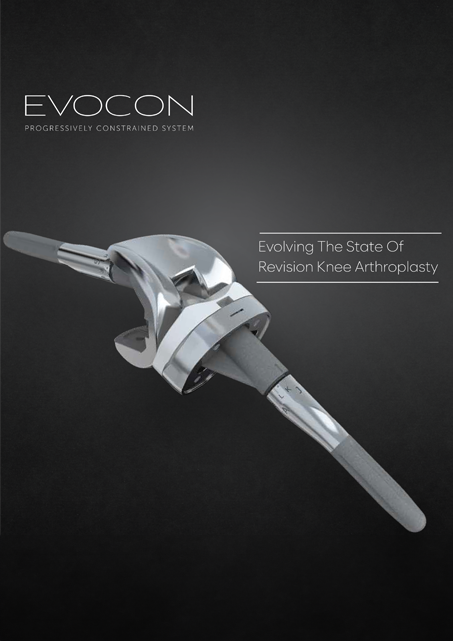
Evolving the State of Revision Knee Arthroplasty

It is one of the most comprehensive revision knee systems, with femoral size starting from 53 mm in AP and the smallest box in its category. It reduces further bone loss. The EVOCON revision knee system has a progressive constrained box that allows full contriteness in extension and 3-degree internal and external rotation for easy flexion. Cam and post have been designed in such a way that it works as a third condylar surface. One of the most robust locking mechanisms for the femoral, tibial rod, and Insert. A versatile system that also accepts femoral/tibial cones and sleeves for significant bone defects. Its surgeon-friendly and accurate instruments make the surgery easier and more precise.​

Buttom-Image
Buttom-Image
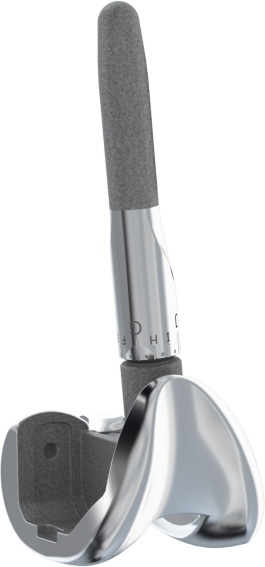
Componente femoral
  • Femoral Component is available in 6 sizes starting from 53 mm
  • The smallest box in its category, reducing bone loss significantly
  • Very robust locking mechanism with extension rod primary locking with taper locking technology and secondary locking by a femoral locking screw
  • Single radii geometry allows the ligamental isometry
  • Anterior flange is reduced for smooth translation of anterior patellar tendon
Offset Extension Rods
  • Offset extension rod has an inbuilt offset of 0 mm, 2 mm, 4 mm, and 6 mm, without any adaptor, reducing the chance of lock failure and reducing the chances of anterior cortex fracture
  • Offset extension rods are grid blasted and fluted, making it suitable for both cemented and uncemented
  • Comprehensive sizing option available, starting from 8 to 20 mm in thickness and 40 to 160 mm in length
  • Accurate instruments make the surgery easier and more precise
View size chartarrow View size chartarrow
Buttom-Image
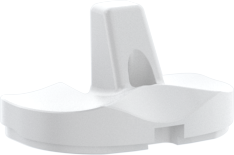
Inserção tibial
  • Deep dish design and proportionate bearing surface for increased contact area
  • Tapered post for progressive constrained effect with the femur
  • Inserts are available in 7 sizes of thickness starting from 9 mm up to 23 mm
  • The deep anterior cutout is provided for patellar tendon relief in mid to high-flexion
  • Inserts are given an anterior hole for the peg post for secured locking and strength to post during high-flexion
  • Inserts are made of UHMWPE from Orthoplastics UK
View size chartarrow View size chartarrow
Buttom-Image
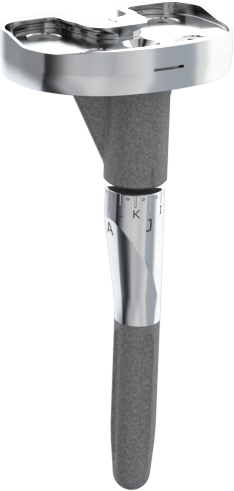
Bandeja Tibial
  • Tibial available in 6 sizes, starting from 55 mm in ML
  • Tibial is at 3° posterior slope with keel
  • Highly polished surface with secure lock technology to lock insert without any micromotion, 4 screw holes for augment locking, and central hole for insert peg screw
  • Very robust locking mechanism with extension rod, primary locking with taper locking technology, and secondary locking by tibial locking screw
  • Accepts screwed tibial augments, both half and full
View size chartarrow View size chartarrow
Image Image
EVOCON Presentation

Assistir à lista de reprodução

Image btn
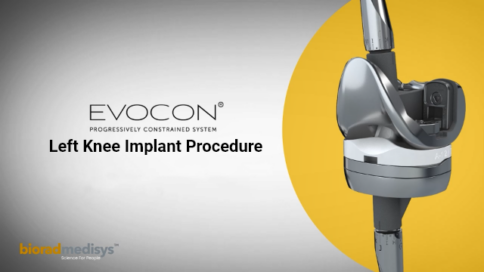
EVOCON Left Knee Implant Procedure
Image btn
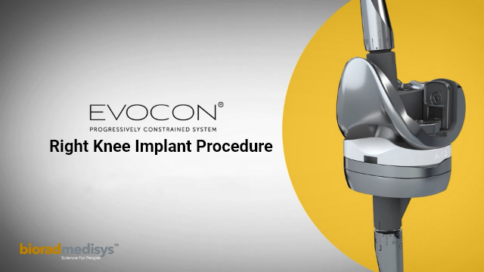
EVOCON Right Knee Implant Procedure

Folheto

Product Code

GENIUS EVOCON - Product Code

Frequently Asked Questions

What makes the GENIUS EVOCON system unique?
The GENIUS EVOCON Revision Knee System is designed for complex revision total knee arthroplasty. It features a progressive constrained design with full constraint in extension and 3° internal/external rotation in flexion, a small femoral box to preserve bone, robust locking mechanisms, and compatibility with cones, sleeves, and augments for managing significant bone defects.
What are the complications of revision knee replacement?
Revision knee replacement is more complex than primary knee replacement and may be associated with complications such as infection, implant loosening, instability, stiffness, bone loss, periprosthetic fracture, blood clots, and delayed healing. Appropriate implant selection, meticulous surgical technique, and rehabilitation help optimize outcomes.
What happens during revision total knee replacement?
During revision total knee replacement, the surgeon removes some or all of the failed implant, evaluates bone loss and soft-tissue stability, prepares the bone, and implants specialized revision components. Depending on the case, stems, augments, sleeves, cones, and constrained inserts may be used to restore alignment, stability, and function.
What is revision knee replacement surgery?
Revision knee replacement surgery is performed to replace a previously implanted knee prosthesis that has failed due to loosening, infection, wear, instability, stiffness, or fracture. The procedure aims to relieve pain, restore stability, and improve function using specialized revision implants designed for complex clinical situations.
What is the difference between primary and revision knee replacement?
Primary knee replacement is the first-time replacement of a damaged knee joint. Revision knee replacement replaces a failed or worn implant and is generally more complex due to bone loss, altered anatomy, and soft-tissue deficiencies. It often requires specialized revision implants such as stems, augments, sleeves, and constrained components.

Produtos relacionados

GENIUS ROTACON

Rotating Constrained System

Explorararrow
volume-unmute-yellow-icon volume-unmute-blue-icon