









While gold is more closely associated with luxury and jewellery, in the medical field, the term ‘Gold’ now represents much more. In a world that often says, “All that glitters isn’t gold“, a new technology in the field of orthopaedics defies this notion by delivering benefits beyond the glitter. Transformative Gold Knee Implants are proving to be an effective solution for the long-standing problem of metal hypersensitivity, thus offering patients a more reliable, durable, and pain-free solution.

Cases highlighting this problem of metal hypersensitivity are those of senior citizens who undergo Total Knee Replacement Surgery (TKR) for degenerative osteoarthritis. Several days after surgery, and discharge from the hospital post-recovery, not all but some of those patients might start experiencing persistent symptoms over a few months, like low-grade fever, swelling, stiffness, and pain in the operated knee, all of which defeat the core purpose of the knee replacement. Subsequent clinical investigation usually shows metal hypersensitivity or allergy associated with the knee implant, which requires revision surgery and an anti-allergy treatment.
So, what exactly happens in such cases?
Let’s understand through this blog1.

THE PROBLEM: Metal Hypersensitivity and Allergy
Degenerative osteoarthritis of the human knee joint, which affects around 500 million people worldwide, or 7% of the global population, can cause severe pain and mobility issues2. Osteoarthritis is when the cartilage that cushions the joints wears away over time, causing the bones to rub together during movement in the affected areas.
While Total Knee Replacement Surgery also known as Total Knee Arthroplasty (TKA), has been a successful orthopedic procedure for patients with severe knee joint damage, it hasn’t always resulted in complete pain relief and restoration of natural joint movement, particularly for patients with degenerative osteoarthritis who undergo the procedure.
Although Total Knee Replacement Surgery has proved to be effective for many, some patients still experience disappointing outcomes, the reason being metal hypersensitivity or metal allergy.
Knee implants made from Cobalt Chromium alloys tend to release metal particles or ions over time due to wear, corrosion, or friction. These metal particles accumulating around the knee joint can cause localized side effects, like inflammation, often requiring a corrective procedure like revision surgery. The entry of these particles into the bloodstream can also elicit an allergic response, also known as metal hypersensitivity. This is one of the reasons for the disappointing outcomes of Total Knee Replacement surgeries3.
THE SOLUTION: Gold Knee Implant
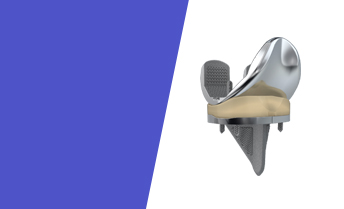
In response to these challenges, the next-generation Gold Knee Implants has been developed to improve the biocompatibility and durability of total knee replacement surgeries. One such technology is the use of a TiNbN (Titanium Niobium Nitride) coating, also referred to as the ‘Gold’ coating, on the implant surface made of cobalt chromium alloys. The use of this coating technology has been proved to reduce the release of metal particles and ions, ensuring a safe and better outcome for patients.
OURO Excel MPK (Medial Pivot Knee)

OURO PS/CR

OURO Excel MPK (Medial Pivot Knee) and OURO PS/CR are two such advanced implants with this cutting-edge TiNbN coating. By applying a layer of this titanium-niobium nitride compound to the cobalt-chromium alloy, the implants offer several advantages over traditional knee implants:
- Reduced Metal Ion Release: Studies have shown that the TiNbN coating significantly reduces the release of metal ions, with a reduction of 80% for Cobalt and 63% for Chromium. This reduction in metal ion release is necessary for patients who are sensitive to such elements and may suffer from allergic reactions post-surgery3.
- Improved Biocompatibility: TiNbN has been shown to exhibit superior biocompatibility along with a better likelihood of integration with the other tissues around the knee. This enhances the healing process around the implant and reduces the adverse reactions4.
- Enhanced Durability and Reduced Wear: The TiNbN coating also has excellent tribological properties, meaning it reduces friction between the implant’s surfaces, leading to less wear and tear, prolonging the lifespan of the implant and ensuring greater long-term durability. The coating’s high hardness also improves the implant’s scratch resistance and resistance to degradation over time3.
- Reduced Risk of Infection: Another advantage of the TiNbN coating is that it prevents bacteria from causing infection. By reducing the ability of bacteria to attach and adhere to implant surfaces, TiNbN helps minimize the risk of infection, especially in knee implants5.

CONCLUSION: A Future of Better Knee Replacements
By reducing metal ion release, minimizing wear and tear, and improving biocompatibility, this innovation is truly transforming the field of Total Knee Arthroplasty. As the field of orthopedics continues to evolve, innovations like these will lead the way in providing better, more sustainable solutions for patients worldwide.
REFERENCES:
- https://journals.lww.com/md-journal/fulltext/2018/09210/metal_allergy_in_total_joint_arthroplasty__case.92.aspx
- https://www.medicalnewstoday.com/articles/prevalence-of-osteoarthritis#:~:text=What%20is%20the%20prevalence%20of%20osteoarthritis%3F&text=Osteoarthritis%20(OA)%20is%20the%20most,over%2032%20million%20have%20OA.
- https://www.intechopen.com/chapters/82486
- https://onlinelibrary.wiley.com/doi/full/10.1002/jbm.b.35357
- https://pmc.ncbi.nlm.nih.gov/articles/PMC7057644/
Frequently Asked Questions
Gold knee implants typically refer to knee implants with a titanium-niobium nitride (TiNbN) coating over a cobalt-chromium alloy surface. The coating is designed to reduce metal ion release and improve surface properties such as hardness and wear resistance. They may be particularly useful when concerns about metal hypersensitivity influence implant selection.
TiNbN-coated knee implants provide an alternative for patients where metal hypersensitivity is a consideration. The coating can reduce exposure to cobalt and chromium ions while providing a hard, wear-resistant surface.
Potential advantages include reduced metal ion release, improved surface hardness, wear resistance, and an option for patients with concerns about metal hypersensitivity. However, TiNbN-coated implants have not consistently demonstrated better clinical outcomes or survivorship than conventional implants. Implant selection should therefore consider the patient's clinical needs, implant design, surgeon preference, and available evidence.
A systematic review found comparable implant survival, complications, and clinical outcomes between ceramic-coated and uncoated TKAs. Studies of TiNbN-coated implants have also reported favorable mid-term outcomes. Therefore, their principal potential advantage may relate to surface properties and reduced metal exposure, rather than guaranteed improvement in clinical outcomes.
Available evidence indicates that TiNbN-coated knee implants can be a safe option, with studies reporting favorable clinical outcomes and no clear increase in complications compared with conventional implants. A systematic review found comparable complication rates between coated and uncoated knee implants. As with any knee replacement, safety depends on appropriate patient selection, surgical technique, implant design, and postoperative care.
TiNbN-coated implants are designed to reduce metal ion release and provide a hard, wear-resistant surface. These properties may be relevant for patients concerned about metal hypersensitivity. However, patient comfort after knee replacement depends on several factors, including implant design, surgical technique, rehabilitation, pain management, and individual patient characteristics.









Leave a comment